Loading...
Serving Quincy, MA and surrounding areas. (617) 691-5917
PaveRight Quincy Concreteserves all 13 of Newton's villages with concrete patio construction, driveway replacement, retaining walls, and steps. We respond within one business day and pull all required permits through the Newton Building Department.
Newton's older homes, large lots, and clay-heavy soil require concrete work calibrated to these specific conditions. Each service below reflects what we actually encounter here.
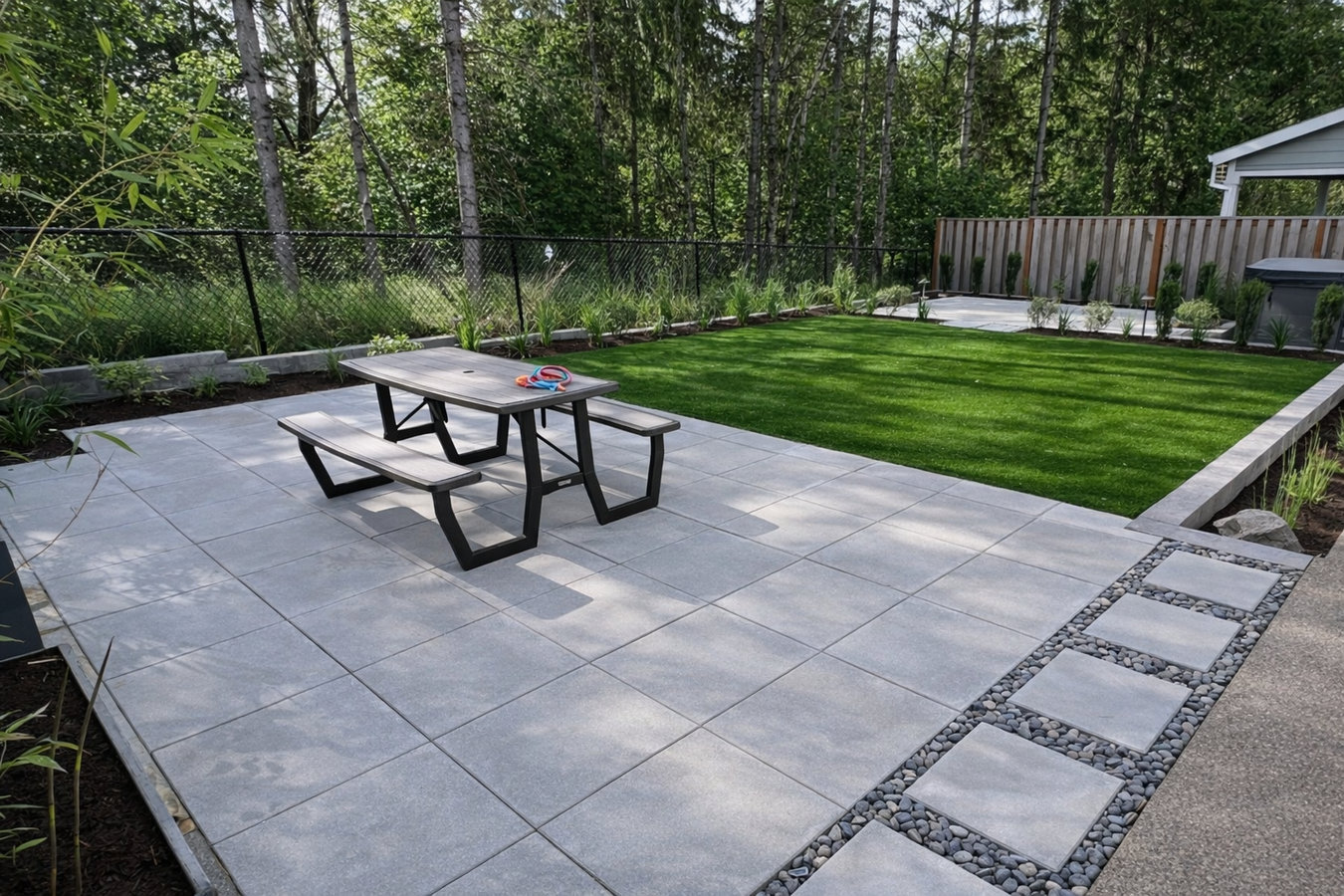
Newton's larger lots - particularly in villages like Waban, Chestnut Hill, and Newton Centre - have the space for substantial outdoor living areas that smaller suburbs don't. A properly built concrete patio with correct drainage slope is one of the best investments you can make on a lot with mature trees and established landscaping, because it handles root-related ground movement better than paver alternatives.
Sloped lots are common across Newton's villages, and many older properties have timber or fieldstone walls that are failing after decades of frost pressure. Poured concrete retaining walls handle the load from clay-heavy soil and seasonal expansion far better than block or timber, and they are engineered with drainage to prevent hydrostatic buildup.
Many Newton driveways were poured or patched decades ago, and root intrusion from mature trees is a common cause of lift and cracking. Replacing the full slab - rather than patching individual sections - eliminates the underlying problem and lets us set the correct base depth for Newton's frost conditions.
Pre-1940 Newton homes often have bluestone, brick, or original poured steps that have shifted or deteriorated. Replacing these with new concrete steps that match the scale and character of older architecture is work we do often in villages like Newton Corner and West Newton where the original entry details matter to the homeowner.
Sidewalk replacement in Newton requires compliance with city standards, especially near school zones and village commercial areas. We coordinate with Newton's Public Works department when work is adjacent to a public way, ensuring the finished panel meets grade and ADA requirements.
Newton averages roughly 48 inches of snow per year, and the city sits on glacially deposited soil with significant clay content. That combination creates a straightforward problem for any outdoor concrete surface: clay holds water, water freezes, and the expansion pushes up whatever is above it. Driveways, patios, and walkways on Newton properties experience frost heave every winter, and a slab poured without the right base depth or mix design will show cracking and displacement within a few years.
The city's housing stock amplifies these demands. Most Newton homes were built before 1960, many before 1940. Victorian-era and Colonial Revival properties in villages like Waban, Newton Centre, and Chestnut Hill have original fieldstone or brick foundations and large lots with mature trees whose roots intrude on driveways and walkways at a scale not seen in newer subdivisions. Any concrete work has to account for root proximity, drainage, and the grade of well-established landscaping.
Newton's building permit process is active and detailed. The city's historic preservation guidelines apply in some village areas, which affects materials and design choices for visible concrete elements. Permits for structural work typically add two to four weeks to project timelines, and a contractor unfamiliar with the Newton Building Department will cause unnecessary delays.
We pull permits through the City of Newton Building Department and have worked on properties across multiple villages, including Newton Centre, Newtonville, West Newton, and Auburndale. Each village has a different mix of housing age and lot size, and we scope projects accordingly rather than applying a single approach across the whole city.
Route 9 and Commonwealth Avenue are the main east-west corridors through Newton, and the Massachusetts Turnpike (I-90) runs along the city's southern edge. Heartbreak Hill on Commonwealth Avenue is one of the most recognized stretches in Newton, marking the difficult final miles of the Boston Marathon course. Boston College's Chestnut Hill campus occupies the western edge of that corridor and defines the neighborhood for property owners in that village.
Our work in Newton connects naturally to our crews in nearby Cambridge, MA and in Quincy, MA, where the same freeze-thaw conditions and aging housing stock drive the same concrete service demand. Boston-area homeowners across these communities share the same seasonal schedule: estimates in late winter, pours beginning in May when overnight temperatures stabilize above freezing.
Call or submit the contact form and we respond within one business day. We ask a few quick questions about your project type and location in Newton so we arrive prepared.
We visit your Newton property to evaluate soil conditions, access, root proximity, and grade. You receive a written quote covering all costs - including permits - before any decision is required.
We submit the permit application to the Newton Building Department on your behalf. Once approved, we schedule your pour date and confirm exactly what preparation is needed from you - typically clearing the area and arranging alternate parking.
Most Newton residential jobs are finished in one to three days. We remove forms and staging, clean the work area, and walk you through cure time before you walk on or drive across the new surface.
We serve all 13 villages of Newton, MA and respond within one business day. No commitment required to get a written estimate.
(617) 691-5917Newton is a city of about 88,000 people just west of Boston, bordered by the Massachusetts Turnpike on the south and Route 128 on the west. Newton is organized into 13 distinct villages - Newton Centre, Waban, Chestnut Hill, Newtonville, West Newton, Auburndale, Newton Corner, Newton Highlands, Newton Lower Falls, Newton Upper Falls, Nonantum, Oak Hill, and Thompsonville - each with its own commercial strip, streetscape, and mix of residential housing.
The housing stock is predominantly pre-1940, with Victorian-era, Colonial Revival, and Craftsman-style homes lining wide, tree-lined streets. Lot sizes are generous by inner-suburb standards, particularly in Waban and Chestnut Hill, where mature trees and established landscaping are defining features. Near village centers like Newtonville and Newton Corner, two- and three-family homes and converted buildings are mixed in with single-family properties. The Heartbreak Hill section of Commonwealth Avenue, famous as the hardest stretch of the Boston Marathon, runs through the heart of the city.
Newton is a natural service area for our crews operating out of Quincy, connecting to other high-demand communities like Cambridge, MA to the north, where dense housing stock and aging concrete create similar workloads. Homeowners across these communities are typically making long-term investments in their properties rather than quick pre-sale fixes, and they expect the work to be done correctly the first time.
Custom concrete driveways built for durability, curb appeal, and long-term performance.
Learn moreAttractive concrete patios designed to expand your outdoor living space.
Learn moreDecorative stamped patterns that replicate stone, brick, or tile at a fraction of the cost.
Learn moreSafe, smooth concrete sidewalks installed to code for residential and commercial properties.
Learn moreDurable garage floor slabs and coatings that stand up to daily vehicle and foot traffic.
Learn moreCustom decorative finishes that add character and color to any concrete surface.
Learn moreStructural concrete retaining walls that prevent erosion and define outdoor spaces.
Learn moreInterior and exterior concrete floor installation for residential and commercial spaces.
Learn moreSlip-resistant, heat-reflective concrete pool decks built for safety and style.
Learn moreCustom concrete steps and stoops built to complement your home's exterior.
Learn moreConcrete slab foundations engineered for stability on any residential or commercial build.
Learn moreFull foundation installation services from site preparation through final pour.
Learn moreCommercial and residential concrete parking lots designed for heavy-load durability.
Learn morePrecise concrete footings that provide the structural base for decks, additions, and buildings.
Learn moreExpert foundation raising and leveling to correct settling and protect structural integrity.
Learn morePrecision concrete cutting for repairs, modifications, and utility access.
Learn moreServing these cities and communities.
Newton's freeze-thaw winters are hard on driveways, patios, and retaining walls. We serve all 13 villages and can schedule your estimate within the week.